Episode 11: Rose

The DAR team explores the first post-reboot Doctor Who episode, “Rose,” the reboot that made the show more popular than it had ever been before.  But, is it as popular among the DAR Crew?

Daleks Aren’t Robots!? is a podcast in which two Whovian friends take two non-Whovians on a deep dive through the show from the very beginning.

Facebook: https://www.facebook.com/daleksarentr…

Twitter: https://twitter.com/daleksrntrobots

Follow us on YouTube: https://www.youtube.com/channel/UC8ngosXDOzVLrJe4KIcW8Qg

Theme: Garage – Monplaisir

Podcast Contents Include

Editor’s Note: The following are my original notes for the podcast, slightly edited for readability. They’re very far from the full contents of the pod, though.  – Kari

THE TEAM

THE DOCTOR:

  1. The Doctor. He’s a worthy successor to the First Doctor, but seems as reluctant to kill sentient creatures as Eight was. He definitely does not seem as deft as Eight, though–he tries to do a card trick and sprays the cards everywhere. And he’s EXTREMELY happy to blow up the building.
  2. He’s very acerbic. He’s equal parts totally flippant and completely earnest. He does seem a bit more self-aware than First and is aware that he thinks the world revolves around him.
  3. He does seem to still be capable of First’s level of bulls***. I assumed that he was bluffing on the “Convention 15 of the Shadow Proclamation” thing he cites but apparently not. We do not understand the Nestene Consciousness’s, the molten plastic thingy’s, words during their conversation so who knows. There’s a great line of bulls*** he slings when Rose asks who he is, about how he feels how fast the world is turning.
  4. He says at one point that he’s been in a war and it’s implied that a lot of worlds died during it, and he “couldn’t save any of them,” including the one that the Nestene Consciousness is from.
  5. This gives the Doctor a more sinister tone–conspiracy theorist Clive says that death is his only constant companion, and that the Doctor only shows up when a disaster is or has occurred. Clive is then proven right by being shot in the face by a mannequin. The Nestene Consciousness, which apparently is legitimately terrified, is also killed, along with a TON of bystanders.

ROSE:

  1. Rose does not seem to be afraid of much, to an almost concerning extent at times. It’s good to be brave but it works better at the beginning when she’s legitimately frightened of the mannequins but keeps asking questions anyway. It’s great that she only screams once in the episode and it’s a very reasonable reaction.
  2. She does react well to crises. She pulls the fire alarm and gets everyone to evacuate when a mannequin impersonating Mickey gets violent in the restaurant.
  3. I like the look of Rose. She’s very pretty, yes, but she’s built like a normal woman and wears normal woman clothing, and her hair looks pretty disheveled a lot of the time.
  4. When her mom calls her during the crisis she hangs up without telling her she’s OK, which is bad. Maybe this is bad editing?
  5. Her associated characters–Mickey and her mom, who is so far nameless–are awful. The mom is the worst, some sort of caricature of a poor person–she doesn’t want her daughter getting “airs and graces,” is implied to be promiscuous and is clueless to the point of stupidity. She’s also careless, doesn’t listen and wants to get money from Rose’s work exploding.
  6. Mickey is annoying, but seemed a little less annoying on the second watchthrough. However, he does want to leave the Doctor behind TO DIE. Even Rose calls Mickey a “stupid lump.” At one point a plastic trash can eats him and I wished he’d stay there. He clings to Rose’s waist and is a coward, is there some racism here? Is this a racism?

TARDIS:

  1. The Tardis has clearly gotten over its indigestion from the Master, because it’s making the “I’m hungry Seymour, feed me!” noise again.
  2. The Tardis looks great, but it is definitely not as large as Eight’s Tardis. It’s also not as liveable, and lacks the homey feeling of the previous one, with its cushy chair and side table and ottoman.
  3. It still has the plasticy tube in the center, but its dome is bronze-looking, with lived-in wear, and green light comes down from it and onto the console, which has a flatscreen monitor attached (must have been fancy back then). Green light shines on the console.
  4. The Tardis has not been spoken of as a person as yet.

THE GUEST STARS/VILLAINS:

  1. Apparently the Nestene Consciousness and the mannequins were in this in previous interations of Doctor Who? But you didn’t need to know that to watch the episode, the Doctor doesn’t explain things a ton anyway. So it’s fine.
  2. Clive is a conspiracy theorist who shows Rose images of the Doctor through history and says he shows up before catastrophes with big death tolls. He is vindicated and then is immediately shot to death.

THE SETTING

  1. The Sonic Screwdriver, what is.
  2. Gay people exist.
  3. Did Genghis Khan really try to get into the Tardis and fail? If so why can Rose just open the door without a key?
  4. The color is fine but unremarkable. No artistic use of color like in the Cushing movie, no unique shots like the TV movie.

THE PRODUCTION

  1. Who decided to reboot the show? Why, what prompted that?
  2. The violence, did it get complaints? There’s a mass shooting at a mall in this episode.
  3. Pacing is too fast. I feel like the right length for this stuff is somewhere between 45 minutes and 2 hours.
  4. Accents and weird class stuff. Why do we hate the poors?
  5. Icky editing, like the part where it cuts a bunch of times on “babe,” “darling,” “dear,” “sweetheart.” That and the “wacky music” makes it more like a children’s TV show than the original, even though that was also a children’s TV show. Like a crappy Disney channel show of this era. What’s with that?
  6. The effects? The show has a budget suddenly?
  7. The novelization, Josh read that, anything from that we haven’t talked about already?

Sources Include

Episode 10: The Doctor Who TV Movie (1996)

In this extra long episode, the Daleks Aren’t Robots!? Team looks at the TV movie from 1996 starring Paul McGann and Eric Roberts.  They discuss the Wilderness Years, the BBC’s multiple attempts to kill the show and the Doctor’s elusive tea preferences.

Daleks Aren’t Robots!? is a podcast in which two Whovian friends take two non-Whovians on a deep dive through the show from the very beginning.

Facebook: https://www.facebook.com/daleksarentr…

Twitter: https://twitter.com/daleksrntrobots

Follow us on YouTube: https://www.youtube.com/channel/UC8ngosXDOzVLrJe4KIcW8Qg

Theme: Garage – Monplaisir

Podcast Contents Include

Editor’s Note: The following are my original notes for the podcast, slightly edited for readability. They’re very far from the full contents of the pod, though.  – Kari

THE TEAM

  1. The Doctor is the main character here, and he’s in fine form. He starts out as Sylvester McCoy, Seven, who I am basically totally unfamiliar with, but who drinks what is apparently black tea, with milk. What kind of tea is canon the Doctor’s favorite?
  2. After he dies the Doctor regenerates into Patrick McGann, a big-R “Romantic” Doctor with long fluffy hair, wearing part of a Wild Bill Hickock costume and looking like a happier and less creepy version of Lord Byron. He seems a lot more psychic than usual (and the Master is psychic too). I am told that this is considered the good-looking doctor, although, having not seen ANY of the others but First, I like Eccleston.
  3. This Doctor, he tells us multiple times, is somehow half human on his mother’s side. Also he has two hearts. Those two things are the only things I originally remembered about Doctor Who from this TV movie.
  4. This Doctor kisses Grace several times during the course of the movie and seems pretty into it, which is fine, because the First Doctor was pretty into Cameca in “The Aztecs.” Both One and Eight are into chicks at least.
  5. At one point the Doctor needs to get somewhere and a cop is blocking him, and he doesn’t threaten the cop–he threatens himself. This Doctor would probably NOT murder someone with a shovel or a rock. He is more stealy than murdery, and does sleight of hand to steal things from people twice.
  6. This is the first regeneration we have ever seen, so is this normal. Is it normal to be kind of manic? Is it normal to lose your memory and just kind of wander around confused? Also does anyone cosplay naked Eight in a sheet? THEY SHOULD.
  7. Grace is the main Companion in this, and also the love interest. She’s smart, great in a crisis, and funny. I like her. She’s a heart surgeon who isn’t able to save Seven after he’s shot a bunch of times, partly because he has two hearts, so she gets lost (surgically) in his chest. Now, the thing is, she had an x-ray that did show the guy having two hearts, which is a thing that CAN actually happen. Bodies can be weird in a number of ways, you can even have situs inversus which means ALL YOUR ORGANS are flipped around. Extra organs are called Supernumerary organs, and extra spleens are so common they’re called “accessory spleens” and more than one in ten people have them. It’d be weird to have an extra heart but not UNHEARD OF.
  8. Chang Lee is an Asian teenager who’s avoiding being gunned down by a gang when he sees Seven get shot. He makes sure Seven gets to the hospital and goes along with him in the ambulance, so he’s not a massive jerk or anything, but the Master is able to trick him pretty easily into helping him, the Master. Is he the first person of color to be a Companion? or just the first Asian person? Does he count as a Companion? I like him, though, he’s a bit cynical but not hard.

THE GUEST STARS

  1. The main other character here is the Master, who is played by Eric Roberts. I don’t know where to start with this guy. Now keep in mind I don’t know anything else about the Master. I have never seen the Master in any other incarnation in any material apart from maybe photographs.
  2. The Master is very, VERY queer-coded and in fact seems incredibly gay for the Doctor, but not in a good way. He’s definitely the s***ty abusive ex here that does not understand how to take no for an answer. He eventually wears this amazing flamboyant set of red and black evil robes and puts the Doctor in this weird fetishy bondage gear torture device looking thing. He said no, dude, and even if he hadn’t like, you didn’t even discuss safewords.
  3. This movie starts out with the Doctor in a voiceover telling us that the Master has finally been executed for his crimes on Skaro, the Dalek homeworld, which… frankly makes no sense to me because the Daleks are not super friendly with the First Doctor, but whatever. Also Skaro is red now and last time I saw it it was a vivid jungle green. So this is interesting, because the Time Lords DEFINITELY have capital punishment. Is this why the Doctor is so murdery?
  4. The Master is in this weird restraint thing that’s a super version of Hannibal Lecter’s restraints, and then he gets zapped into ash and put into an urn so the Doctor can bring him back to Gallifrey. Then he turns into, and I am not exaggerating, snot. For the first part of this movie the Master is literally a slimeball, and someone steps in him when he’s a slime puddle, and eventually he becomes a snot snake, and then he steals the body of an ambulance attendant played by Eric Roberts and stays there for the rest of the movie.
  5. What the f*** IS the Master? The premise here is that he is out of lives and needs to steal the Doctor’s body to stay alive but during this movie he can slime people and burn them with burny slime, and his eyes glow green-yellow and he can possess someone and hypnotize people into doing what he wants them to do. The Doctor can’t do any of these things, are they even the same species?
  6. There are some other people but none who are particularly important. The morgue attendant is meant to be comic, but no one really cares. Also is it that weird for some dude to come out of a refrigerator? He doesn’t look at all like the guy the morgue attendant just put in there, wouldn’t he just assume someone snuck in there or was hiding there from before somehow?
  7. Also Grace has a boyfriend named Brian who leaves her after she has to go to work because she’s on call during a date. When he leaves he takes the sofa but NOT HIS SHOES, LIKE A CRAZY PERSON. Also there’s an eccentric scientist in charge of the atomic clock at the fancy event, and there’s a stoic unbending security guard there too.

THE SETTING

  1. The time tunnel looks great, and we also actually get to see it DURING the movie, not just in the credits.
  2. The Tardis interior looks FANTASTIC. It’s warm and homey and has kind of a steampunk look to it, with lots of dark wood and dark metal, and a cushy chair and a record player.
  3. The Tardis is CONFIRMED TO EAT PEOPLE. The Doctor says it literally has indigestion at the end after it has just eaten the Master. Also at one point the Doctor says “The Tardis is dying” and I was like “Yeah, you haven’t fed it for EIGHT LIFETIMES.”
  4. There’s a lot of confusing stuff in this episode. I don’t know what the Eye of Harmony is, I don’t know why the Doctor is half human and they even mention he can change his species upon regenerating? Is that why he’s half human? I don’t know really who the Master is, other than that he’s bad and is SUPER into the Doctor and wants his body, probably on multiple levels.
  5. And I don’t know whose Tardis this actually is but when the Doctor says it’s his I thought: The hell you say, sir, I believe it is NOT yours. Also the Tardis can resurrect dead people?

THE PRODUCTION

  1. Why didn’t this work? This obviously didn’t kickstart a new era of Doctor Who. I liked the movie when I saw it when it originally aired, and I think it holds up really well too. It’s well shot and at one point there are chickens. It seemed good so why didn’t it work?
  2. This wasn’t through the BBC and seems to have been an American thing, what’s with that?
  3. Did they have trouble getting Seven back? What did he think of it all?
  4. Why did they choose the companions they did?
  5. Was the Master meant to be that gay? has he always been gay or at least, into the Doctor, since their genders have both swapped now at least once.
  6. How much did this cost, what were the ratings?
  7. What was the fan response?

Sources Include

Episode 9: Dr. Who and the Daleks

The DAR team looks at the first of the Peter Cushing movies, Dr. Who and the Daleks.  Is it an improvement on the original Doctor Who serial?  What’s the official favorite color of the Daleks?
Daleks Aren’t Robots!? is a podcast in which two Whovian friends take two non-Whovians on a deep dive through the show from the very beginning.

Facebook: https://www.facebook.com/daleksarentr…

Twitter: https://twitter.com/daleksrntrobots

Follow us on YouTube: https://www.youtube.com/channel/UC8ngosXDOzVLrJe4KIcW8Qg

Theme: Garage – Monplaisir

Podcast Contents Include

Editor’s Note: The following are my original notes for the podcast, slightly edited for readability. They’re very far from the full contents of the pod, though.  – Kari

THE TEAM

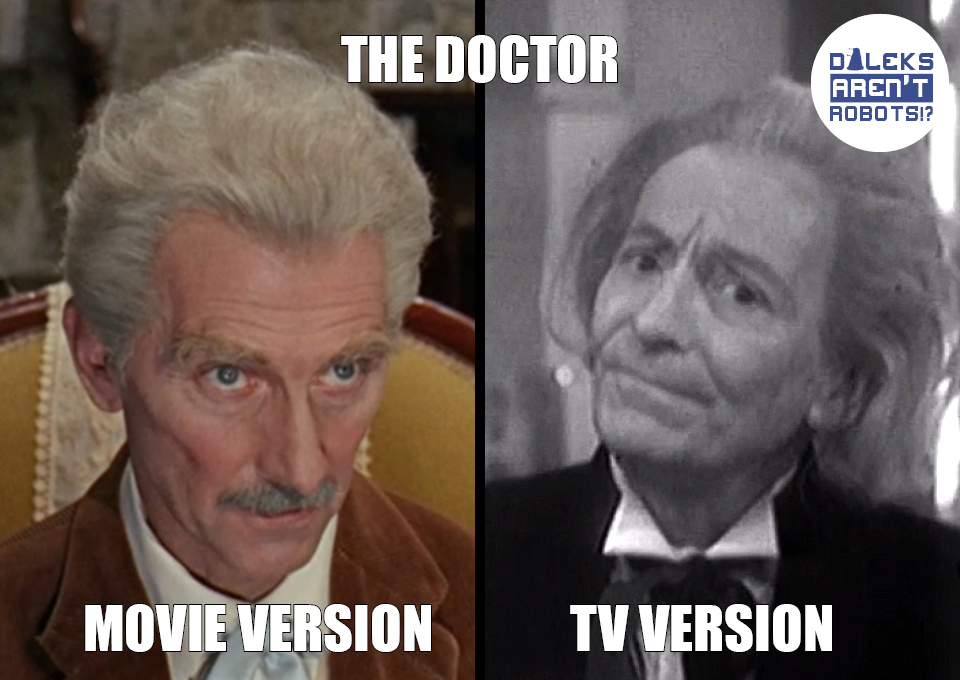
  1. The Doctor is a human man, a scientist, and invented the TARDIS. Also, his name is actually Dr. Who and he APOLOGIZES to someone.
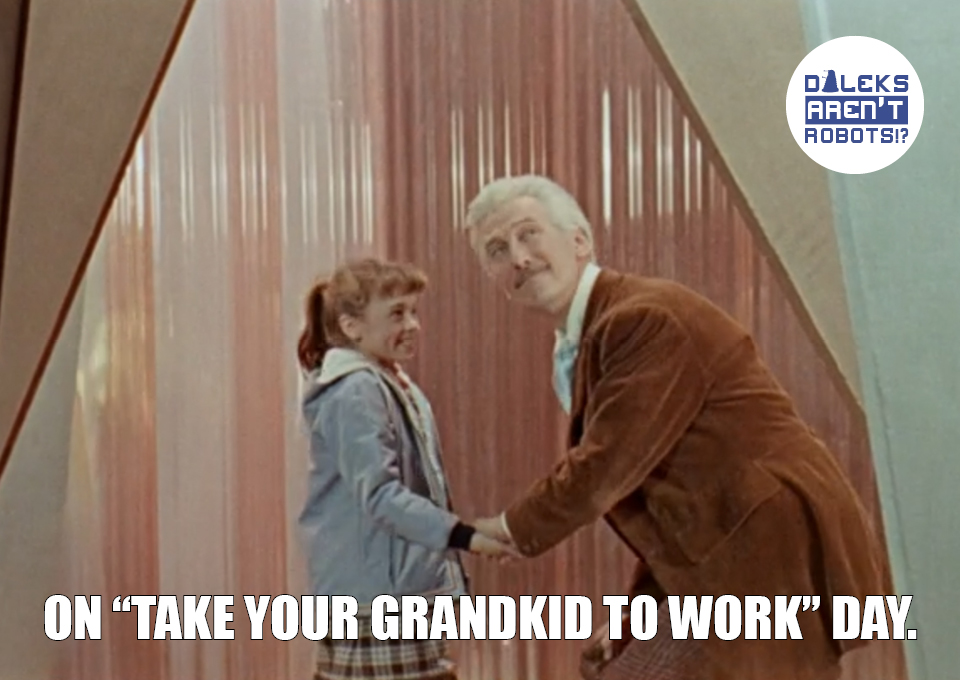
  2. He’s also a kinder and gentler and less murdery version of the Doctor, although maybe that’s just because Barbara is his teenager granddaughter and Ian is Barbara’s boyfriend. He’s more watchful of Susan as well, but that’s because…
  3. Susan is now a kid instead of a teenager. She’s still a smart, capable kid, but everyone is a bit more protective of her. She takes out the Dalek camera with a pen, which is impressive.
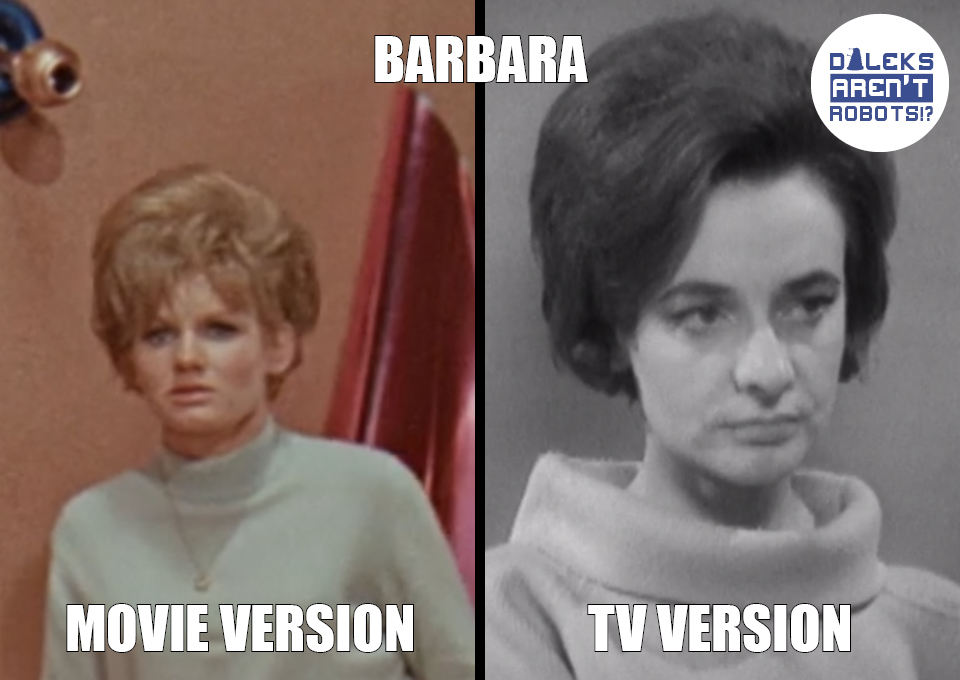
  4. Barbara doesn’t really have a niche here anymore. She doesn’t seem to do a ton in the plot, but at least she’s not damseled.
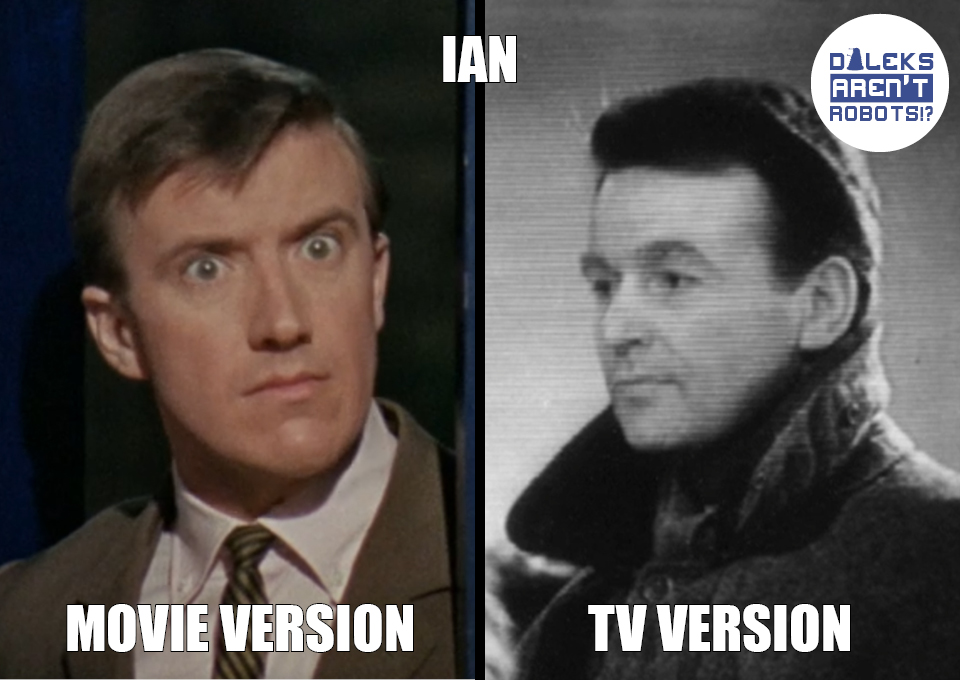
  5. Ian is the biggest change. He’s now Barbara’s boyfriend, and his main characteristic is that he’s clumsy and this moves the plot forward sometimes–for example, he accidentally hits the lever of the TARDIS and prompts the first time and space jaunt. This Ian is still protective of Susan, though, and while he’s a bit less physically capable he’s pretty brave. And not inclined to mansplain at all.

THE GUEST STARS

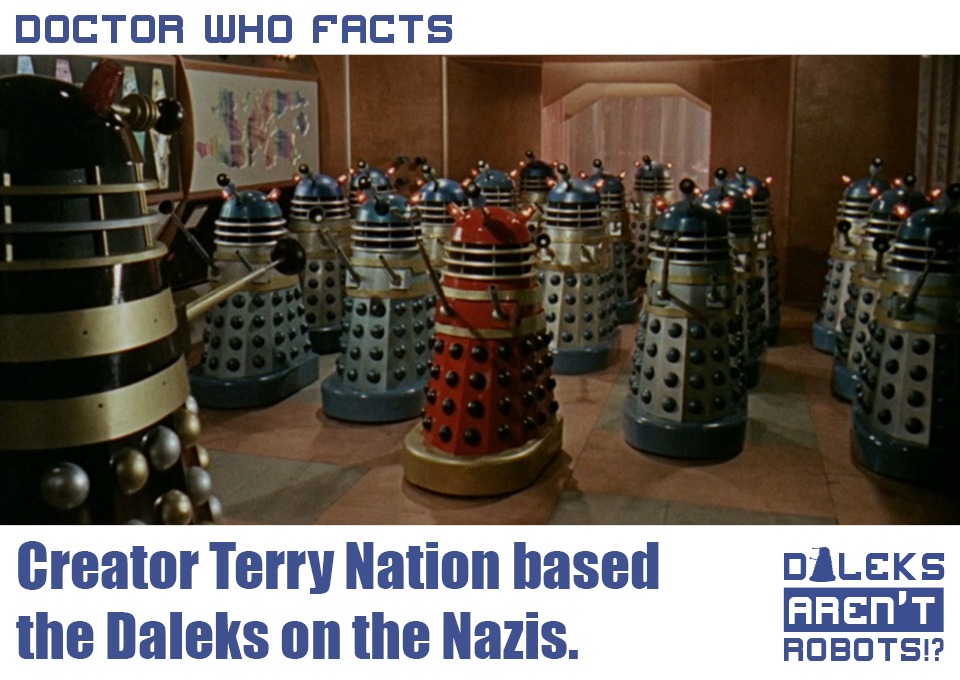
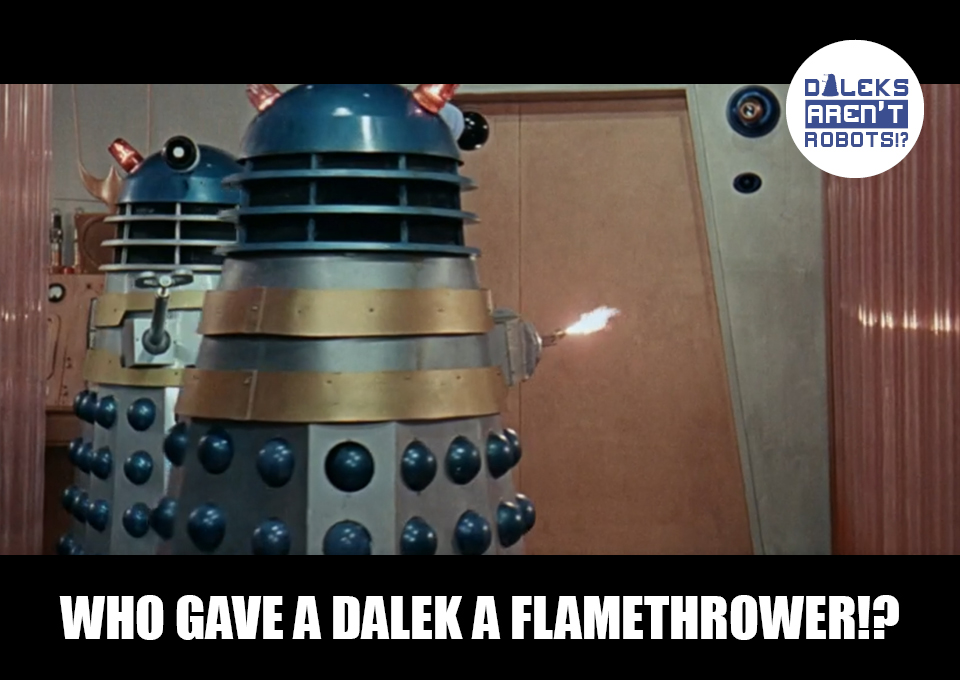
  1. The Daleks come in color, they’re M&M Daleks in blue and red and black. They’ve also been given some upgrades. Now their rays are visible sprays of something and some of them have pincers for grabbing stuff. Later one has a FLAMETHROWER/welding torch thing.

  2. There’s also a scene that more explicitly ties Daleks to fascism–when they’re all lined up in a formation and a lead Dalek is giving a speech.
  3. These Daleks might be different creatures entirely than the ones we saw in the show, as when they remove the Dalek from its can it seems to have a claw. Also, it stops moving, so maybe they killed it?
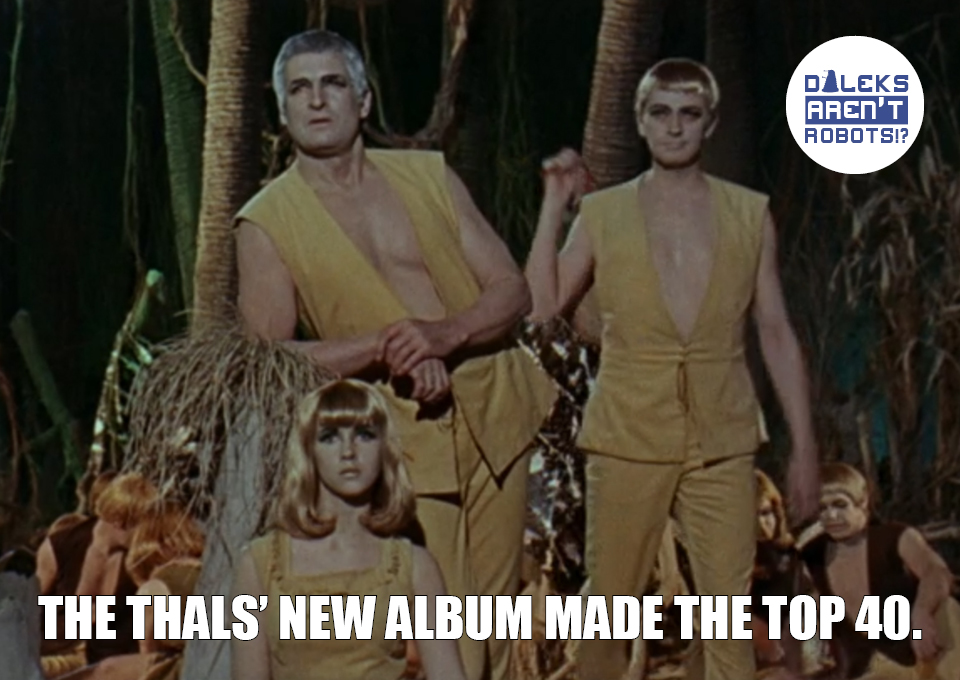
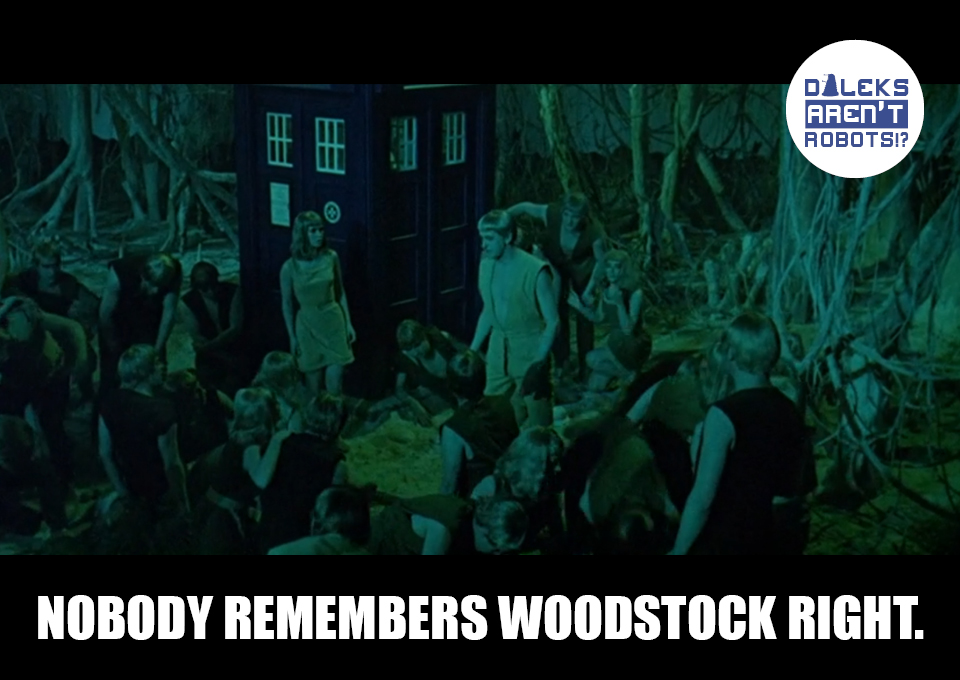
  4. The Thals are still fabulous and they’re much MORE fabulous in color, with their weird blond wig hair, their gold-pale skin and their hilarious Cruella DeVille eye makeup. It’s a very specific style of makeup and it is bizarre to see on a whole group of people. Unfortunately they have lost their cool hats and fascinators. 😦

THE SETTING

  1. It is great to see these locations in glorious color. Skaro exteriors are intensely green; the interior of the Daleks’ city is very pink. It’s all very candy-colored, with lots of soft pastels and bright, cheerful hues.
  2. The Dalek city has some pretty outre decor. Twisty mirror sculptures on the walls, funky satellite-looking sculptures on the exterior.
  3. They call the Tardis Tardis rather than THE Tardis. It is much larger than the regular Tardis.
  4. Susan writes her letter to the Thals by the light of three glorious lava lamps.
  5. There’s a beautiful matte painting of a hill that Ian and Barbara and some Thals have to climb.
  6. The consoles we see are much more real-looking and complex than the ones in the show–they clearly had real sets. But they were also beautiful–the Doctor’s radar-looking thing is vivid blue and purple, the Daleks’ map of Skaro has a beautiful pearlescent sheen, and the Tardis’s interior is a chaotic mass of many-colored hanging wires and doodads.

OTHER CHANGES

  1. The pacing is better here than it was in the show, because they don’t need to fill time, but there are still some spots where it drags, particularly in the caves.
  2. The Thal guy who falls in the cave doesn’t die this time.
  3. The Thal archives aren’t Settlers of Cataan tiles anymore, they’re geometric cubic shaped things that were once probably redshirts on the Enterprise.
  4. They use mirrors to confuse the Daleks’ sensors, but it doesn’t work.
  5. At the end they try to go home, only to open the door to the Tardis and get charged by apparently Romans.

THE PRODUCTION

  1. Why? Just why.
  2. Why the changes in cast? Why the other changes? Why did they keep what they kept?
  3. How did the cast feel about it?
  4. How much money did it make?
  5. How many years between?

Sources Include

Episode 8: Reign of Terror

Today, we look at “Reign of Terror,” a Doctor Who story that sees the TARDIS team travel to revolutionary France.  Will they lose their heads?  Will we lose ours? Will we confidently discuss French politics despite not knowing anything much about it? (Yes. Yes we will.)

Daleks Aren’t Robots!? is a podcast in which two Whovian friends take two non-Whovians on a deep dive through the show from the very beginning.

Facebook: https://www.facebook.com/daleksarentrobots

Twitter: https://twitter.com/daleksrntrobots

https://www.youtube.com/channel/UC8ngosXDOzVLrJe4KIcW8Qg

Theme: Garage – Monplaisir

Podcast Contents Include

Editor’s Note: The following are my original notes for the podcast, slightly edited for readability. They’re very far from the full contents of the pod, though.  – Kari

THE GUEST STARS

  1. There are only humans in this one, and they’re all French, except for one English spy. They are the most British French people since Star Trek: The Next Generation.
  2. I had a hard time telling some of the characters apart sometimes, and it was harder during the animated parts–this is another one where we’re missing some episodes. In this case the BBC commissioned the missing episodes to be made as cartoons. The animation is good but a little uncanny at times.
  3. I feel like the historicals where they don’t have to work with any specific people might be better so far, because that way they don’t have to work around reality. For example, Robespierre is in this and he had to end up executed, yes, but before that he also had to be badly wounded in the jaw, which was actually significantly gorier than this episode showed, and I can do without that kind of historical accuracy.
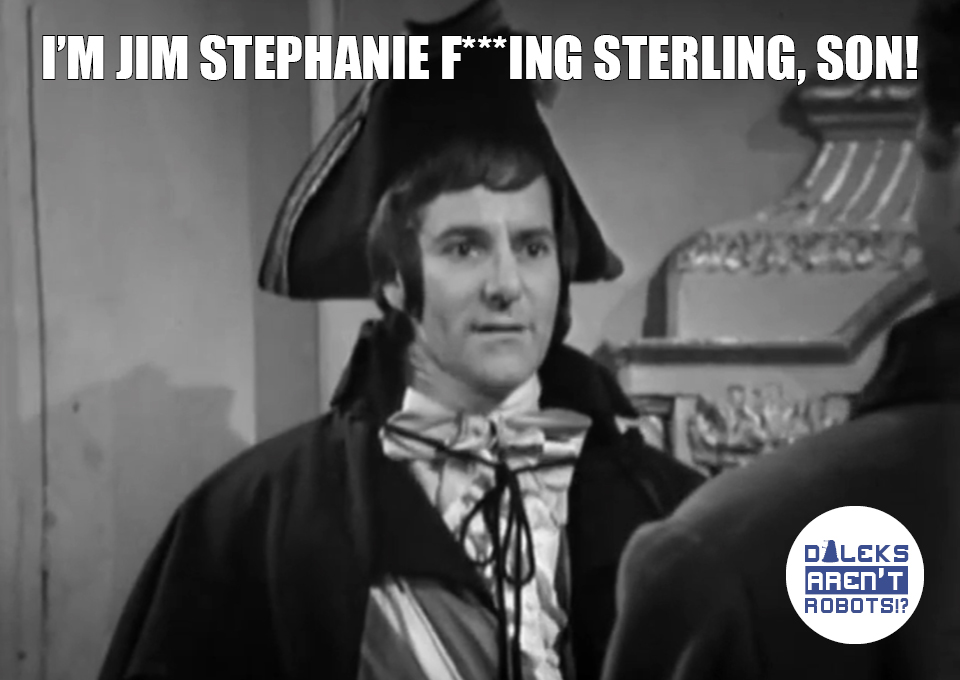
  4. There are some important French guys. Jules kinda looks like Miles O’Brien on Star Trek and he is working to rescue aristocrats from the guillotine. One, Leon, is a guy who hits on Barbara and turns out to be a super obvious traitor, meaning he believes in the Revolution. And one, LeMaitre, is an important official with the revolution who seems to be the main antagonist at first but then turns out to be an English spy. His other name, and I am not kidding, is JIM STEPHANIE F***ING STERLING SON. (Editor’s Note: Jim Stephanie came out as nonbinary just after this episode was recorded but before it was released; I’ve edited these notes accordingly but we did not re-record the podcast episode.)

THE TEAM

  1. The Doctor has a LOT of cool moments in this one, as he’s split off from the rest of the team for a lot of it. He finally gets to murder someone, although the guy starts snoring afterwards as if we’re dumb enough to think that people knocked unconscious with a high-velocity shovel would be a. alive afterward, b. snoring and c. totally fine when he wakes up, guys.
  2. The Doctor gets into trouble due to his ego, but then gets out of it with trickery and also a shovel.
  3. The Doctor also gets to pull a con and trick a bunch of people into thinking he’s an important official in the French revolutionary government. This involves wearing an absolutely incredible hat as well as some pretty awesome clothes.
  4. Susan is useless again in this episode, and that is sad. She gets to wear a cute dress, but then she gets sick and doesn’t do much the rest of the time.
  5. Barbara figures out a way to escape a French prison, she gets flirted with by a bad guy, and she’s pretty awesome throughout. Her dress isn’t as cool as it should be and certainly does not measure up to the Doctor’s hat.
  6. Ian meets an English spy and then helps him; he also gets tied up and tortured for a while, which is nice. He does some action stuff. At one point he and Barbara apologize to each other.

THE SETTING

  1. The show really takes a side here against the Revolutionaries, which… I’m not saying that they don’t have a good point, because they beheaded a lot of people and by the time we look in on the story we’re to the point where they’ve started purging their own ranks with the guillotine.
  2. At the same time, we get a lot of nefariousness from the rebels without any recognition of the cause of the revolution–a massive increase in population and unemployed people, plus a massive increase in food prices due to bad harvests. The cost of living increased 62% in just 44 years. Peasants were 80% of the population but owned 35% of the land. Meanwhile, the Crown was having a debt crisis, partly caused by helping the Americans during their revolution.
  3. Like, there was a lot going on and if you starve people to death don’t expect them to be sweet and kind and nice and good when you sit in a massive castle eating fancy food all day.
  4. There’s some dispute that the “traitor” was a bad person, mind you, but it seemed really token to me.
  5. At one point when Susan gets sick they go to a doctor, and the doctor indicates he’s going to bleed her. Fortunately they get arrested again first, but shouldn’t they ALL know not to go to a doctor of this era??
  6. The women’s hair is terrible for the era and no one ever comments on it or suggests they cover up the mess with a hat or a wig.

THE SHOW

  1. I think this one gets bogged down a little bit in its details. If you think about it, it gets hard to remember what happened when and why, meaning that even though things are continually happening it gets fuzzy about why.
  2. It’s also super hard to care about the NPCs, since starving the peasants is wrong and bad, and chopping heads off is also wrong and bad.

I know you guys reviewed Revolution of the Daleks and no spoilers but I have to know: Do the Daleks get a hat like the Doctor’s?

Sources Include